

Case study — advisoryBuilding AI Act readiness at leadership level in Irish financial services
The challenge
Across Irish financial services, the EU AI Act is not primarily a legal or technology problem. It is an organisational one. Institutions using AI in customer-facing products, credit decisions, or internal workflows face obligations around transparency, human oversight, AI literacy, and fundamental rights impact assessments - many of which require structural change to how teams operate, not just how systems are configured.
For senior leaders, the challenge is not a lack of awareness that AI Act obligations exist. It is the absence of a shared understanding of what those obligations mean in practice for their organisations - and no clear picture of what a compliant, well-governed organisation actually looks like from the inside.
Case study – Advisory
Building AI Act readiness at leadership level in Irish financial services
What we did
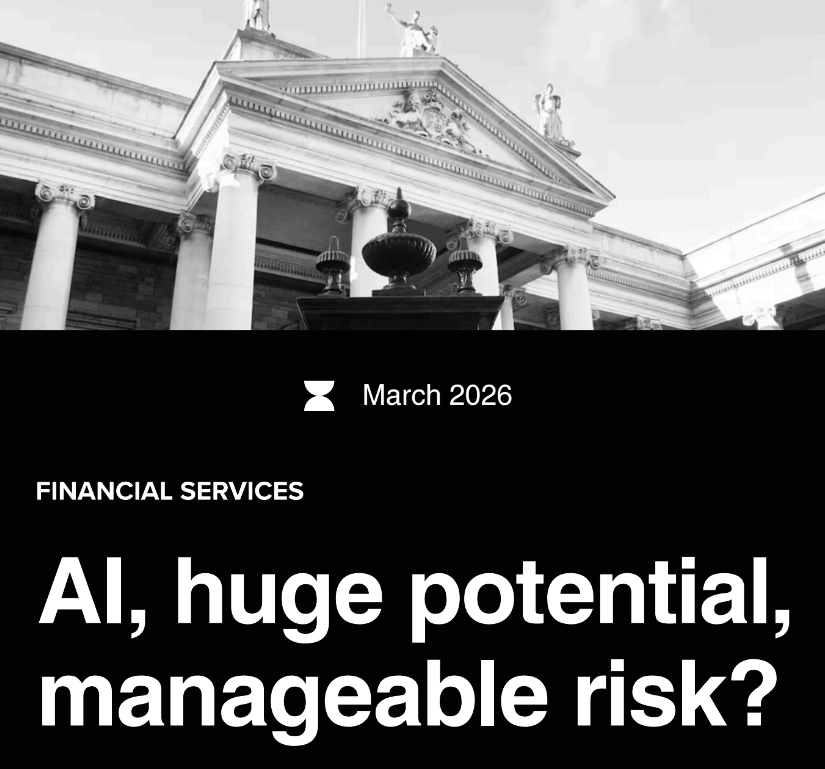
In March 2026, Delve convened 37 senior leaders from across Irish financial services at the Governor's Boardroom, Bank of Ireland, College Green - one of the most significant gatherings of financial services leadership on AI governance in Ireland to date.
The session brought together speakers with complementary expertise: Michael Dowling (Narrative Banking) on the state of AI across the sector; Louise McCormack on AI governance, ethics by design, and ISO 42001; Andrew Newman on how AI is already reshaping high-stakes investigation and commercial decisions; and a panel discussion including Dr Barry Scannell (William Fry LLP, Irish Government AI Advisory Council) and Justin Walker (Mastercard).
The event operated under Chatham House rules - creating the conditions for candid conversation that formal conferences rarely allow. Senior leaders from the following organisations attended:
The agenda was structured around two questions that matter most to decision-makers: where is the real potential, and is the risk genuinely manageable? The afternoon covered the state of AI adoption in financial services, the practical implications of the EU AI Act for how organisations are structured and governed, the design obligations landing in August 2026, and what it means to build AI literacy at a level that satisfies Article 4.
"Winning hearts and minds - getting colleagues to see AI as an accelerator rather than a threat - will make the difference. Practical, hands-on approaches can break that barrier."
– Edward Conmy, CEO, DelveKey insights from the room
The gap in financial services is not between those who know about AI and those who don't. It is between those who are thinking about it and those who are doing something about it.
Risk under the EU AI Act is manageable - but only if organisations evaluate their current readiness, define what a compliant organisation looks like, and act before the August 2026 deadline.
Competitive advantage lies not in public AI tools but in proprietary knowledge of your own industry and processes. Building that into your AI infrastructure is what separates leaders from followers.
Winning the AI transition is fundamentally a people problem. Literacy, culture, and change readiness matter as much as the technology itself.
What happened next
Following the event, Delve is engaged in ongoing EU AI Act readiness assessments with participating organisations. With August 2026 obligations approaching - including new transparency requirements for AI systems used in customer and colleague-facing contexts - the focus is on helping leadership teams understand where they stand, what needs to change, and how to build the organisational capability to sustain compliance over time.
The assessments are structured around the areas where change is most likely to be required: ways of working, governance structures, AI literacy programmes, and the design of human oversight into existing processes.