

Fast forward (deployed) – new AI job titles, old work
Forward-deployed engineering roles have grown 42 times since 2023. In three years the role has gone from invisible to the zeitgeist. The role is focused on making AI work inside an organisation. Embedded with the teams using it, connecting the technology to how the business runs. It is an important addition to most org structures, and like anything named well, it captures the imagination. But what does the wider AI roles picture look like?
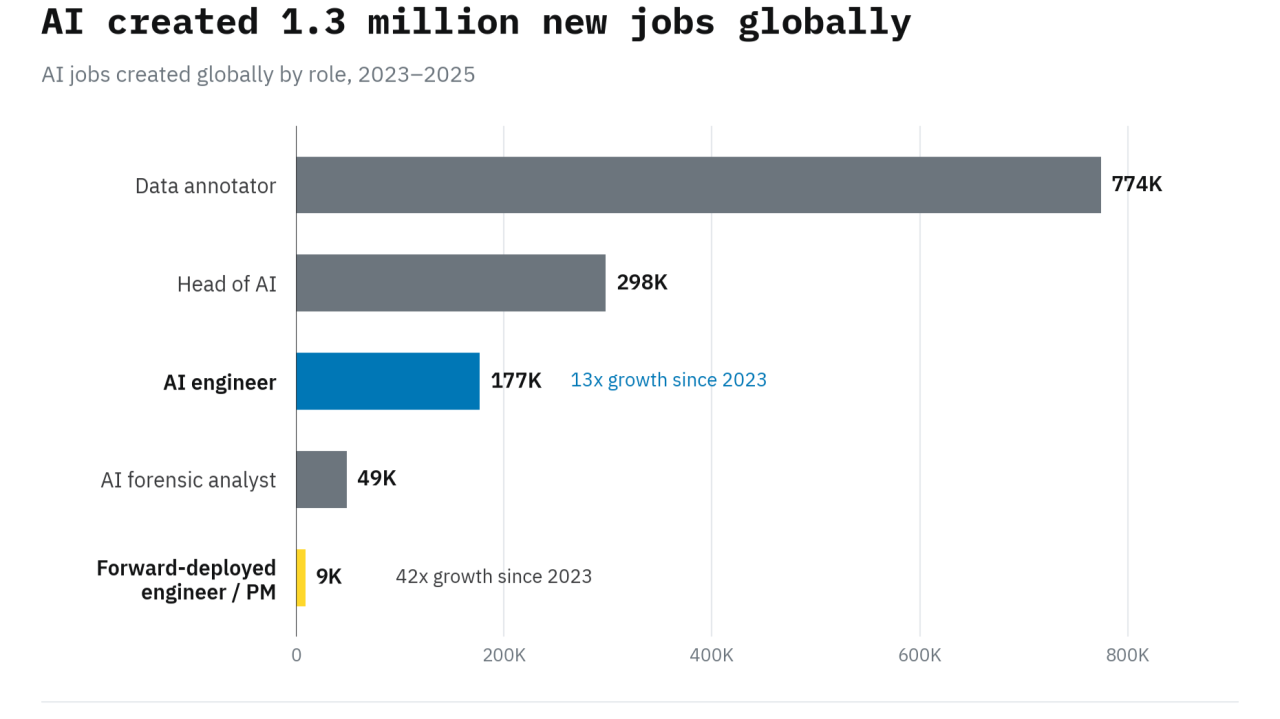
LinkedIn puts the number of AI jobs created globally between 2023 and 2025 at 1.3 million. Forward-deployed engineers account for 9,000 of them. 42x growth is interesting, but it's growth on a small base. I found more interesting insights in the narrative around other emerging titles.
AI job names, new and emerging
The largest group by far is data annotators, at 774,000. These are the people who label, tag, rate and correct the data AI models learn from. In practice that means transcribing audio, drawing boxes around objects in images, checking whether search results and ads match what someone was looking for, and rating which of two chatbot answers is better. Much of it is contract work, often remote and often through outsourcing firms.
LinkedIn describes these as roles that didn't exist five years ago. I'm not so sure. Search "data annotation" on LinkedIn in Ireland and you get 111 jobs. Only the first ten or so carry the full title of data annotator. The rest are testing, ads and transcription roles, work that has existed for years under other names.
The same applies further up the chart. The 177,000 AI engineers, growing 13x, are the real workhorse behind the 1.3 million. Many of them were presumably software or data engineers a few years ago, doing similar work with new tools. Even the forward-deployed engineer has history – Palantir created the role in the mid-2000s to get its software working inside government agencies. So "new" deserves a caveat. A good share of the 1.3 million is likely existing work with a new title.
Then there are 298,000 Head of AI and similar leadership roles. More people are leading AI than building it. It's a familiar corporate pattern – appoint the leader, announce the strategy, underinvest in the people who have to make it work. It frustrates staff, and it keeps happening.
This is why the forward-deployed role is interesting. LinkedIn categorises it under AI change management. Read the chart as an org structure and you get a large layer at the top setting strategy, a larger layer at the bottom preparing data, engineers building in the middle, and very few people connecting any of it to how work gets done. In my experience, that connecting work is where AI programmes stall.
If much of the 1.3 million is existing work with a new title, the instinct to hire the new title deserves some scrutiny. The work of connecting technology to operations has always existed. Business analysts, service designers, change leads and the operations manager everyone calls when a new system goes live have been doing it for years. LinkedIn's own data points the same way, stating that companies can grow their AI talent pipeline 8.2 times by hiring for skills over job titles.
Before hiring a Head of AI or a forward-deployed engineer, map the work. Find out who already connects your technology to how the business runs, and give them the tools and the mandate. Then hire for the gaps that remain. Skip that step and you add another layer to the top of the chart, while the connecting work is done by your AI vendor's forward-deployed engineers. And we all know that IP leaves when their contract ends.
For anyone making AI hiring or structure decisions this year, I'd recommend reading the full report from LinkedIn's Economic Graph Research Institute. If you're working out who connects AI to the work in your organisation, that's what we do at Delve, happy to talk.