

Ireland ahead in AI talent inward migration
OpenAI established their European HQ in Dublin in 2023, with plans to grow from 100 to around 350 staff. CEO Sam Altman cited a workforce that "blends talent with support for innovation and responsible business growth". Anthropic followed in 2024, selecting Dublin as its EMEA base. By 2026, President Daniela Amodei announced a further 250 planned roles to meet enterprise demand across Europe. Most of the large AI infrastructure and product companies now have significant Irish operations. So where does that leave Ireland globally? According to LinkedIn's Economic Graph report of Jan 2026, Ireland is a net importer of AI engineering talent. Only the UAE outpaces us in new arrivals with explicit AI skills.
At the other end, Israel and India are net exporters - with India, given its population, exporting by far the most AI engineering talent globally. Germany sits just behind Ireland at 2.1, presumably driven by demand for AI in manufacturing automation. It is worth remembering in this context that AI engineering is not all chatbots, industrial applications are a significant part. But what does Ireland's position as a large importer of this kind of engineering practice mean in the wider economic context?
We have been here before. The pharma industry followed a similar pattern – tax incentives and an educated workforce attracted the first wave of investment. That first wave created a concentration of specialist talent, which attracted more investment, which deepened the talent pool further. Forty years later, nine of the top ten global pharmaceutical companies have significant operations in Ireland and the sector employs over 50,000 people directly.
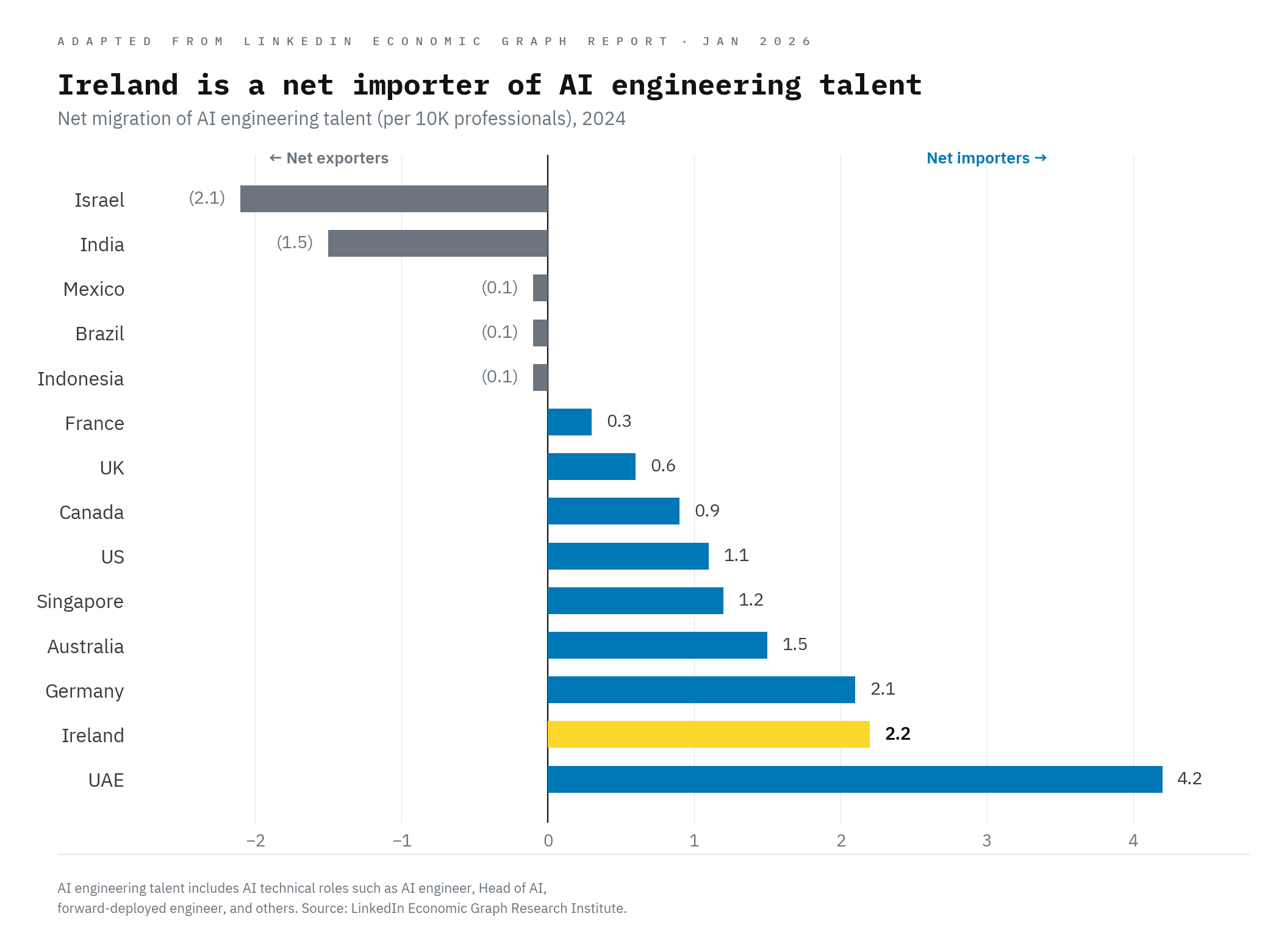
The ingredients for a similar cycle in AI are already in place. Competitive corporate tax rates, EU market access, an English-speaking workforce, and a growing base of AI infrastructure companies that bring their own talent pipelines with them. The data suggests a similar outcome. Ireland's net inward migration of AI engineering talent at 2.2 per 10K professionals puts us ahead of Germany, the US, and Singapore.
The question is whether that momentum compounds or stalls. Pharma succeeded in Ireland partly because the ecosystem developed around it – education, supply chains, regulation, specialist services. AI will need the same. And it comes with harder questions about how the technology reshapes work, the impact on environment and utility infrastructure, what it means for existing roles, and how organisations integrate these new capabilities without disrupting the things that already function well. These are difficult and multi-faceted problems for leadership in politics and business.
For anyone leading an Irish operation that is hiring or planning to hire AI talent, the structural decisions you make now – where these roles sit, how they connect to the business, what you're asking them to deliver – need to consider this macro context. The talent pool available today, its cost, and the specific skill sets on offer will all shift as investment patterns evolve over the next five years. Leaders who treat AI hiring as a series of individual recruitment decisions rather than a strategic workforce play risk building for a landscape that has already moved on.
Ireland attracts more AI engineering talent per capita than the US, Germany, or Singapore. Only the UAE is ahead of us. Attracting talent and absorbing it are two different problems - have a read #AIadoption #changemanagement