

The hiring slowdown is macro, not AI
Most people blame AI for the hiring slowdown. I've always had a hunch it was more nuanced. That in fact the end of ultra low interest rates, or ZIRP, was the main driver. LinkedIn's latest Economic Graph report backs this up. It plots the US hiring rate against the real interest rate from 2019 to 2025. The two lines move almost perfectly in opposition - as interest rates climbed from 2022 onwards, hiring fell in near-lockstep.
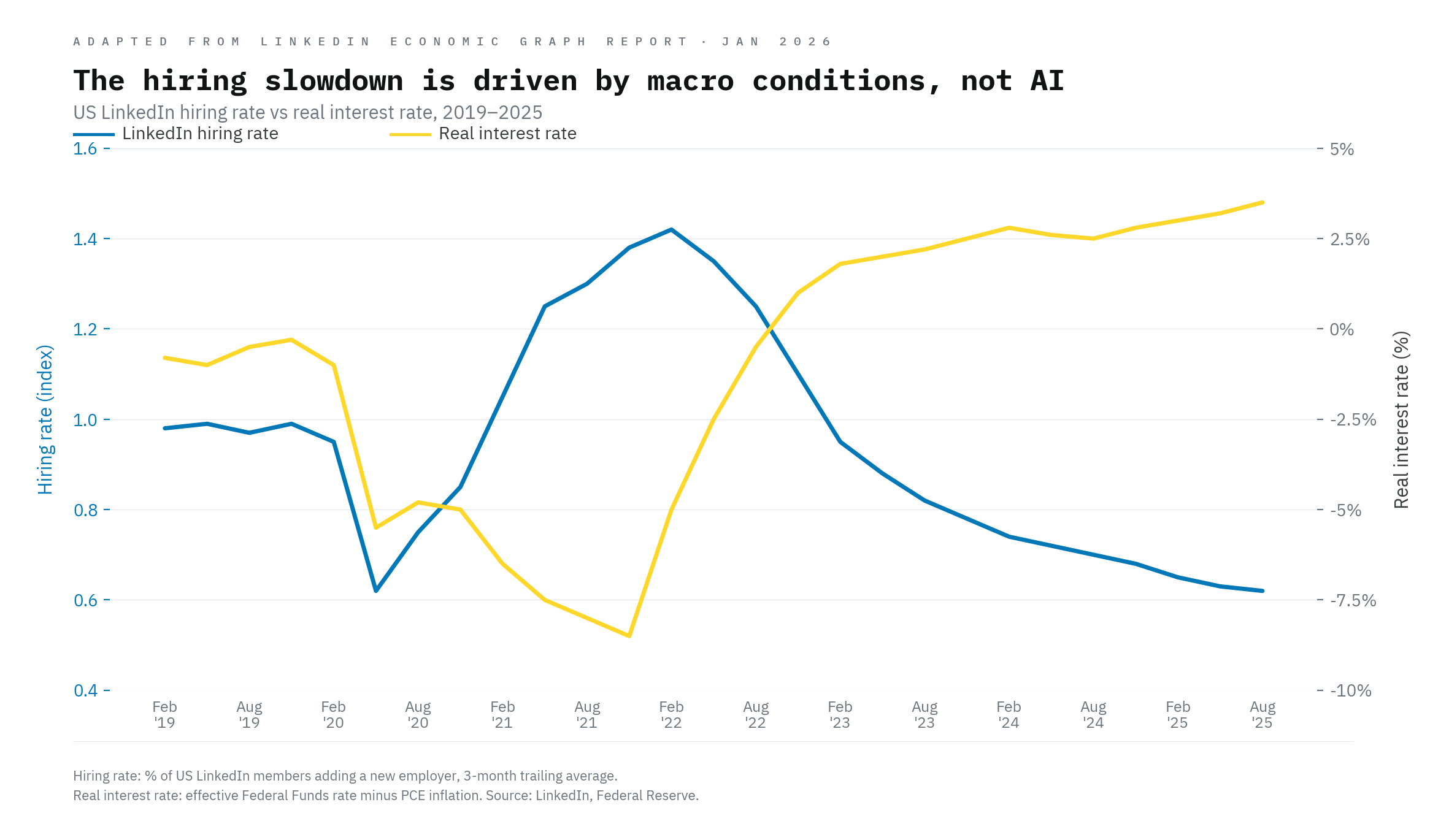
You should resist the urge to use AI as the explanation for everything. Headcount down? AI. Restructuring? AI. Slower hiring? AI. Not so, says LinkedIn's data - across 1.3 billion professionals. Roles with high AI exposure in administrative, customer support, and marketing functions are not declining any faster than roles with low exposure. Entry-level hiring mirrors experienced hiring almost exactly.
When you are planning a change programme, one of the first things to do is make sure the diagnosis is right. A restructure designed around the assumption that AI is eliminating roles looks very different from one designed around a cyclical economic downturn. The first leads to permanent cuts and capability gaps. The second leads to selective investment and positioning for recovery.
The risk right now is that leaders use AI as a catch-all justification for decisions that are actually driven by cost pressure, margin protection, and uncertainty about demand. These are strategy questions – and they need to be treated with the same rigour as any strategic decision, not wrapped in a technology story.
For anyone navigating workforce planning or restructuring decisions in 2026, I'd recommend reading the full report from LinkedIn's Economic Graph Research Institute. The data is specific, well-sourced, and more nuanced than most of the commentary it will generate.
If you are making structural changes to your organisation and want to make sure the diagnosis is right before the design begins, that's what we do at Delve, happy to talk.